We all look to go on a golf tour to some pretty different places sometimes. More humid, rainier, hotter, colder, higher or windier. Our desire for a change up can really test the versatility of our golf games. But it does not mean changing your swing necessarily. It means taking into account the environmental factors before you take that swing.
Photo : Peter Drewe
Temperature
As air gets colder, it gets more dense. Add in fog and it gets even more dense. Ball flight meets greater resistance. The common rule is that for every drop of 5°C the ball will fly 2 metres less on a driver than on a warm summer’s day (say 21°C). Add to this your muscles are colder and you naturally cannot swing as faster.
I use a rule that if I have a second layer on, I go up a club. Inversely if it is hot (say over 30°C) you will notice that the ball will fly further and you will need to consequently adjust.
Elevation
The higher you go the less air resistance you have . If you go on one of our tours to Canberra and play at Gold Creek (elevation 640m) or a golf tour to Orange (850m) and play on a warm day, you could notice that you are hitting the biggest drives of your life. The PGA tour regularly plays in Mexico City (elevation 2240m) and the pros notice that they are crushing it a lot further.
The general rule is for every 300m of height, the ball will fly 2% further. So at 600-900m of altitude for a 150m shot at sea level, it will be a 140m -145m shot at those elevations. The inverse works if you play at altitude and go down to sea level for a game. Canberra and Orange golfers all talk about this adjustment!
Golf at altitude at Gold Creek Country Club in Canberra
Humidity
Humidity or moisture in the air can adversely affect ball flight. Playing in a cold, fog are probably the heaviest conditions which we discussed in this previous post. However in just sticky conditions, the ball will fly further as moisture is lighter than the nitrogen and oxygen that it replaces. It is not highly significant compared to other factors but it is there.
Wind
Wind is the biggest factor on ball flight. A headwind increases spin and lift which reduces ball flight. A tailwind increases ball flight but reduces spin so the ball will roll out more. Wind will exacerbate or reduce any of your natural shot shape depending on it’s direction.
The ability to keep the ball low in high winds can be beneficial but otherwise take more club and swing smooth (when it is breezy, swing easy) which will reduce loft of the ball flight.
But how much more club should you take. A common method to work out the amount of “hurt” you are going to face is the “Faldo method”. Throw a piece of grass into the wind. Pace out how far it flies. For every pace add 4 metres of loss of distance to your ball flight into the wind. Half it if you are hitting downwind.
Rain
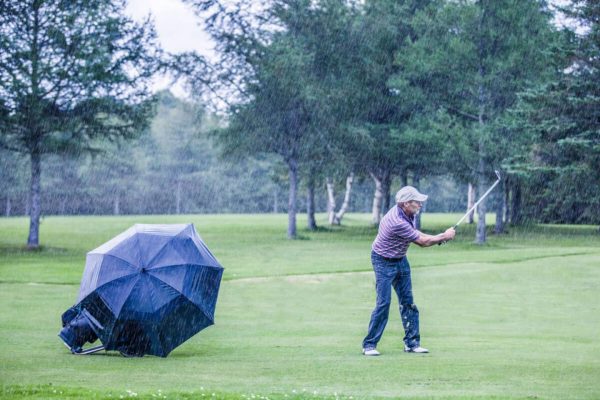
If it is physically raining, then ball flight is going to be affected. However a wet club face is going to reduce the amount of spin on a ball so on firm greens which have not become waterlogged yet, there is going to be less bite on the green.
Keep your club face dry before hitting and adjust your expectations when playing in the rain. If you don’t have a caddy helping you, it is going to be harder. There can be satisfaction from grinding it out!