
Is winter golf harder?
The Scots probably invented golf as a summer sport. Those long summer days out on the links. Heaven. But the game has travelled to other climes and obsessed golfers want to continue their passion eventhough the weather might become colder. Winter golf is definitely more challenging. Golf club match committees are familiar with how temperature blows scores out. Frequently the best competition results come from later and warmer in the day. Even the USGA has an active and inactive season allowance for handicapping.
But it doesn’t have to be doom and gloom. Here are ten tips so you can enjoy and play better winter golf.

1. This is all about your attitude…
In any of the football codes when a game is played in bad weather, the team that wins is the team that wants to be on the ground at that time. Coaches know this. So a positive attitude to playing in winter is essential. You must be looking foward to it and looking forward to the positives and the challenges. Also adjust your expectations. Winter golf is more challenging. The ball doesn’t fly as far, the ground is probably wetter. You are going to have play differently. Enjoy that difference.
2. Go lower in the bag
Let us confront the elephant in the room. Ball flight is affected by temperature. In cold weather the air is denser. Even worse in foggy weather. Just the same as it flies higher and longer in summer, it drops like a stone in winter. Tests conducted on Trackman for someone who hits it 230m, show that the difference between when it is 38°C and when it is single digits, can be by more than 10m for the driver right through to the 7 iron, less so for the pitching wedge and below. Added to that, your muscles are colder and they are not going to function as well when it is warmer. You are not going to able to swing as fast!
So take more club than what you do during the warmer months. I use a general rule is that if I have a layer on, I go one club up. If it is two layers, it is two clubs up. Just let the ego go for this time of year.
3. Layer up
Dressing up for winter golf does not mean you should be looking like “Michelin Man” or you just returned from the ski slopes. You can wear light, snug layers such as long sleeve thermals or polartec that sheds moisture and keeps warmth around your body. I often wear a windproof vest under a good jumper if it is going to be windy just to reduce the windchill. That way the body is protected and the arms are free for the golf swing. Maybe have a light windproof that lives in your golf bag so just in case you get surprised how cold and breezy it is when you arrive at the course.
Also if it’s particularly cold, leave the golf cap at home and bring a beanie or a warmer hat. You lose 90% of your body warmth through your head. You are going to be a lot happier on the course with a warmer head.

4. Keep your balls warm!
Naturally we are talking about the ones you put on a tee here. Golf balls can be affected by temperature so keep a spare one in your pocket and alternate holes with the one that you are hitting. The ball flies better and you will be ready to pull one of out of your pocket in case you need to hit a provisional.
5. Different strokes for different times of the year.
Winter can be good time to learn some new shots which might come in handy at other times of the year. One is to use a hybrid more for those chip shots that you run onto the green. With the ground wetter during winter, using a wedge often requires you to nip it off a sodden lie. Otherwise you hit it fat and it goes nowhere. A hybrid will skip across the ground and run onto the green.
Also with the wind blowing across trouble left and right, rather than hitting it high and playing “Russian Roulette” with the wind, use a half-swing on a mid-iron. Tour pro Adam Scott calls it “a chippy 6 iron”, to keep it low and run it up and onto the green.
6. Change your shoes
With golf shoes increasingly starting to look like joggers or casual dress shoes, you are going to need a proper golf shoe if the course is a little slimey or frosty. A spiked or an agressive sole on spikeless shoe is going to work better on the softer ground in winter time.
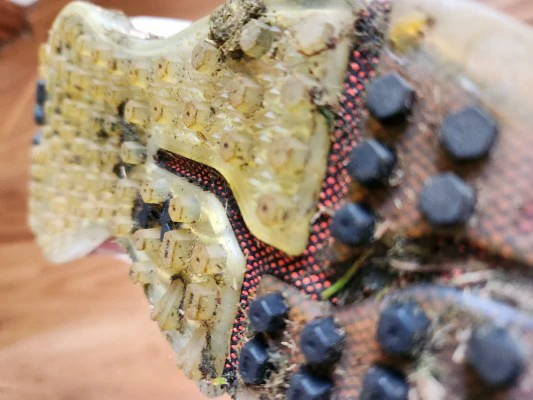
7. Have a clean sole
If you unable to change your usual tee time to later and a more warmer part of the day (as is our suggestion) then you may sometimes be forced to play in frosty conditions. Difficult for play and a good time to have a different colour of ball in the bag. Also your shoe soles may start to collect an annoying slab of ice on the bottom.
This is happening because the sole of your shoes is dirty and the ice is attaching and collecting around the dirt. If you are going to be playing in frosty conditions, brush all the grass and dirt from the sole of your shoes and the attached spikes (if you have them). Then get some warm, soapy water and clean those soles. Let them dry and go out and play.
You may find some collection of ice in time as dirt and grass sticks to your sole but it will be a lot better. Hopefully the frost will melt early enough in your round so you will enjoy it more.

8. Make sure you warm up properly
Some of our clients have turned up one and a half hours before their round to warm up, others sit in the cart as their warm up. There is no way in winter, that you can get away without preparing the body for a golf round. The golf swing is an athletic movement and you’ll be more likely to pull something than hit a good golf shot, if you are not warmed up.
If you do some stretching exercises in the warmth of your home beforehand, do that. At the course, start with some putting and chipping, then go to the range or into the practice net before your tee time . Greg Norman suggests this as a way still to be warm and ready for your 1st tee shot.
9. Be aware of the winter conditions of play
Golf courses can come under stress during winter as there can be water or tree damage to the course. Make yourself aware of the local rules like preferred lies, GUR and any hole changes before you start playing. Consult the noticeboard or the local pro for the information.
10. Have a golf break and go to a warmer climate
Sometimes just having a break from the cold weather can be a great for your tolerance of winter . Especially if you from the inland, the coast can feel like the Bahamas when you arrive. Also hotel prices are cheaper, the humidity is lower and there are less crowds. The greens can also be firmer so as to give you a nice roll.
We have a number of itineraries for golf trips to the coastal areas like the South Coast, the Central Coast and a great one for anyone to travel to in the winter time, the Coffs Coast. Hit the links to check them out and to make your plans!